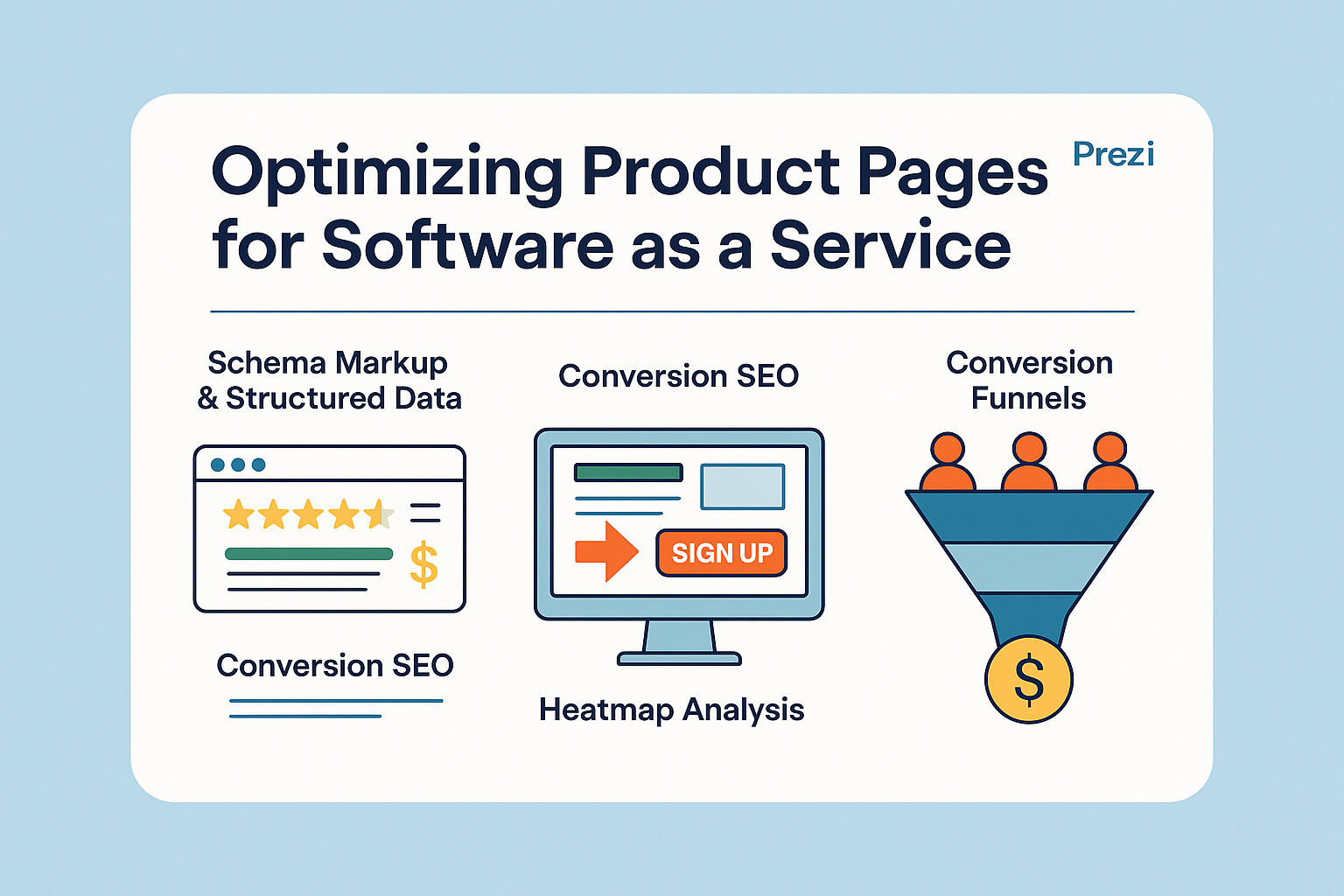
The fast-paced SaaS market often involves the product page being the first and last point of contact before a lead becomes a customer. Even though marketing print, email campaigns, and free trials come in earlier, it is the product page that needs to give the final push. The improvement of this page requires a combination of SaaS product optimization, technical SEO best practices, persuasive UX design, and thorough A/B testing. This guide will lead you through a walk of the proven methods you can use— from schema markup and conversion SEO to heatmap analysis and conversion funnels— to alter your product pages to be the high converting engines for growth.
1. Creating the Technical Base
1.1 Schema Markup and Structured Data Implementation
Rich snippets may help you increase your click-through rates up to 30%. By embedding structured data—like the SoftwareApplication schema—you let search engines present:
- Product ratings (from user reviews)
- Price (via pricing tables)
- Application compatibility
<script type=”application/ld+json”>
{
“@context”: “https://schema.org”,
“@type”: “SoftwareApplication”,
“name”: “Your SaaS Product”,
“operatingSystem”: “All”,
“applicationCategory”: “BusinessApplication”,
“aggregateRating”: {
“@type”: “AggregateRating”,
“ratingValue”: “4.7”,
“reviewCount”: “125”
},
“offers”: {
“@type”: “Offer”,
“price”: “49.99”,
“priceCurrency”: “USD”
}
}
</script>
With the help of schema markup, you tell Google everything relevant— sending more targeted traffic and assisting your overall conversion SEO efforts.
1.2 Load Speed and Mobile Usability are Priorities

Page speed is a crucial ranking factor and one of the essentials forming a good user experience. Compress images (for instance, WebP), use lazy-loading for non-critical resources first, then apply a Content Delivery Network (CDN). Then, you can assess the mobile performance by using Google Mobile-Friendly Test. Adapting mobile page speed facilities to quick responsive pages corollary to increased time on site and fewer bounce rate – two great elements contributing to the better search index and driving visitors to your CTA.
2. Creating Persuasive Content
2.1 Feature Descriptions That Resonate
Your text must find a balance between being clear and being persuasive. For every feature:
- Headline: Concise and beneficial
- Micro-Description: 1–2 lines explaining the “why”
- Visual: Icon or screenshot to reinforce understanding
Example:
- Real-Time Analytics
See key performance indicators as they happen, empowering data-driven decisions.
By feature descriptions in all, you navigate the readers through a logical reasoning—growing authority and trust in the process.
2.2 User Trust Signals and Reviews
Customer proof is a major relief for any last-minute doubts from customers. Show these:
- ★★★★★ client reviews
- Security badges (e.g., “ISO 27001 Certified”)
- Logos of famous clients
“Malinovsky, our SEO agency partner, helped integrate a dynamic testimonial slider – lifting conversions by 12% in one month.”
This brief mention of Malinovsky is a good way to credit your team as well as show your proficiency in SaaS product optimization.
3. Designing for Conversion

3.1 Strategic Pricing Tables
A clearly arranged pricing table translates choices into simple decisions. While arranging it, it is good to remember the following:
| Plan Tier | Key Feature | Price/Month | Savings (Annual) |
| Starter | Basic Dashboard | $29 | — |
| Professional | All Starter + API | $59 | 20% |
| Enterprise | All Pro + Support | $99 | 30% |
Emphasize on a “Most Popular” tier to leverage the anchoring effect.- Promote the annual-billing savings using a more expensive choice.
- Make the way in by offering a free trial or freemium plan.
3.2 Optimizing CTAs and Conversion Funnels

Your main Call to Action (e.g., “Start Free Trial”) has necessarily to pop out through color contrast, whitespace utilization, and convincing microcopy (for instance, “Start My Free Trial Now”). For CTA optimization:
- Position buttons above the fold and at logical scroll points.
- Try color, size, and wording through A/B testing.
- Outline your conversion funnels: from the landing page click to the trial sign up to the payment conversion. Determine the drop-offs and reinforce those points with contextual cues (e.g., inline FAQs, chat widgets).
4. Validating with Data: Heatmap Analysis & A/B Testing

4.1 Heatmap Analysis to Discover User Behavior
Tools such as Hotjar and Crazy Egg will help you to know where users click, scroll, and stay the longest. The most useful data points are:
- Most popular locations (good for you to change CTAs)
- Content sparse (the areas that don’t get attention)
- Preposterous interactions (mistriggers that drain focus)
Take these references to adjust layout and focus on elements that generate actions.
4.2 The Never-Ending A/B Testing
You can never be right with just your own thoughts. Set up your tests around:
- Hypothesis: “Switching the CTA from blue to orange will increase clicks by 10%.”
- Variant: Color, wording, button position.
- Metrics: Click-through rate (CTR), trial starts, paid upgrades.
Actuate fast and every winning variation will wait to make it to your next control in the conversion SEO process.
5. Advanced Techniques for SaaS Product Pages
5.1 Personalized Experiences
Make the most of the information about your visitors (source medium, industry, company size) and use it to tailor content:
- Replace general headlines with specific ones (e.g., “The CRM Platform for Real Estate Pros”).
- On the known company size, pre-select plan tiers.
- Use exit-intent modals to offer specific discounts or content upgrades.
These techniques are the engine of your conversion funnels matching the page directly to user’s alike.
5.2 Interactive Tools and Calculators
Enable self-serviced calculators that allow visitors to finger out their costs or ROI:
“Why not try our ROI Calculator? It will show you how much informed decisions could save you in 6 months of automated workflows.”
Interactive tools do not only keep your clients busy but also gather good data about prospects you can use to improve your lead-scoring system — a tactic often integrated into data-driven SEO for tech companies.
5.3 Social Proof through User Reviews
Instead of embedding just static testimonials, think of embedding:
- Live review feeds (from G2, Capterra)
- Case study snapshots with real metrics
- Video testimonials for emotional impact
Each review makes the impression of trust signals, showing the visitors that their peers recommend асy the solution.
6. Measuring Success and Iterating
6.1 Key Performance Indicators (KPIs)
Monitor these metrics for page condition:
- The statistics for organic traffic and keyword positions (mainly the phrase “SaaS product optimization”).
- Engagement metrics: bounce rate, time on page, and scroll depth.
- Conversion metrics: trial starts, demo requests, and paid upgrades.
When testing strategies, you can correlate improvements in page elements like adding structured data or refining feature descriptions with KPI shifts.
6.2 Feedback Loops and User Research
Do not rely on quantitative data only. Mix:
- Live chat transcripts to find recurring objections.
- Post-trial surveys asking “What almost stopped you from signing up?”
- Usability tests that allow you to watch first-time interactions in real time.
These iterative usability studies are not only the devices through which you make future site improvements but also the reason your product page is kept up to snuff with your target audience’s needs.
Final Thoughts
Product pages for Software as a Service are the optimization of the multidisciplinary nature of this process. By intermixing schema markup technical SEO techniques, compelling content such as feature descriptions and trust signals, and driving experiments based on data such as A/B testing and heatmap analysis, you become a conversion powerhouse. Whether it be the streamlined pricing tables & CTA optimization or mobile usability & conversion funnels working thoroughly – each element is essential in guiding the prospects toward “Sign Up”.
Keep in mind that effective SaaS product optimization is outside the box and cannot be done only once. It’s a path of constant measuring, testing, and improving. You should learn from the next time you check your analytics panel whether it’s the conversion rates, scroll maps, or schema-driven impressions, and convert it into a push for your product page to be as close to perfection as it can be. Customers (and also your revenue) will be very glad to thank you.
Optimizing Your SaaS Landing Pages in 2025 | Liraz Postan | Whiteboard Friday | 4K