Preface
Since zero-click search makes many searches end without a click, tech brands have to rethink their strategies for getting the customers’ attention. It is not about website visits anymore but rather about taking over the results page right through the search engine. Companies through featured snippets, knowledge panels, and SERP features are able to develop visibility and authority directly in front of their audience. Indeed, as much as 65% of the worldwide Google search requests do not get any clicks through, mobile devices contributing over 75% to this. At Malinovsky, we have witnessed how tech brands adapt and change digital strategies with the help of this e.g. startups through to enterprise players.
In this article, you are going to find out what zero-click searches are, their significance for technology companies, and how to arrange content in a way to secure answer boxes, list snippets, paragraph snippets, and others. You will also know the ways to assess the success of digital marketing when traditional click metrics alone will not tell the whole story.
What Are Zero-Click Searches?
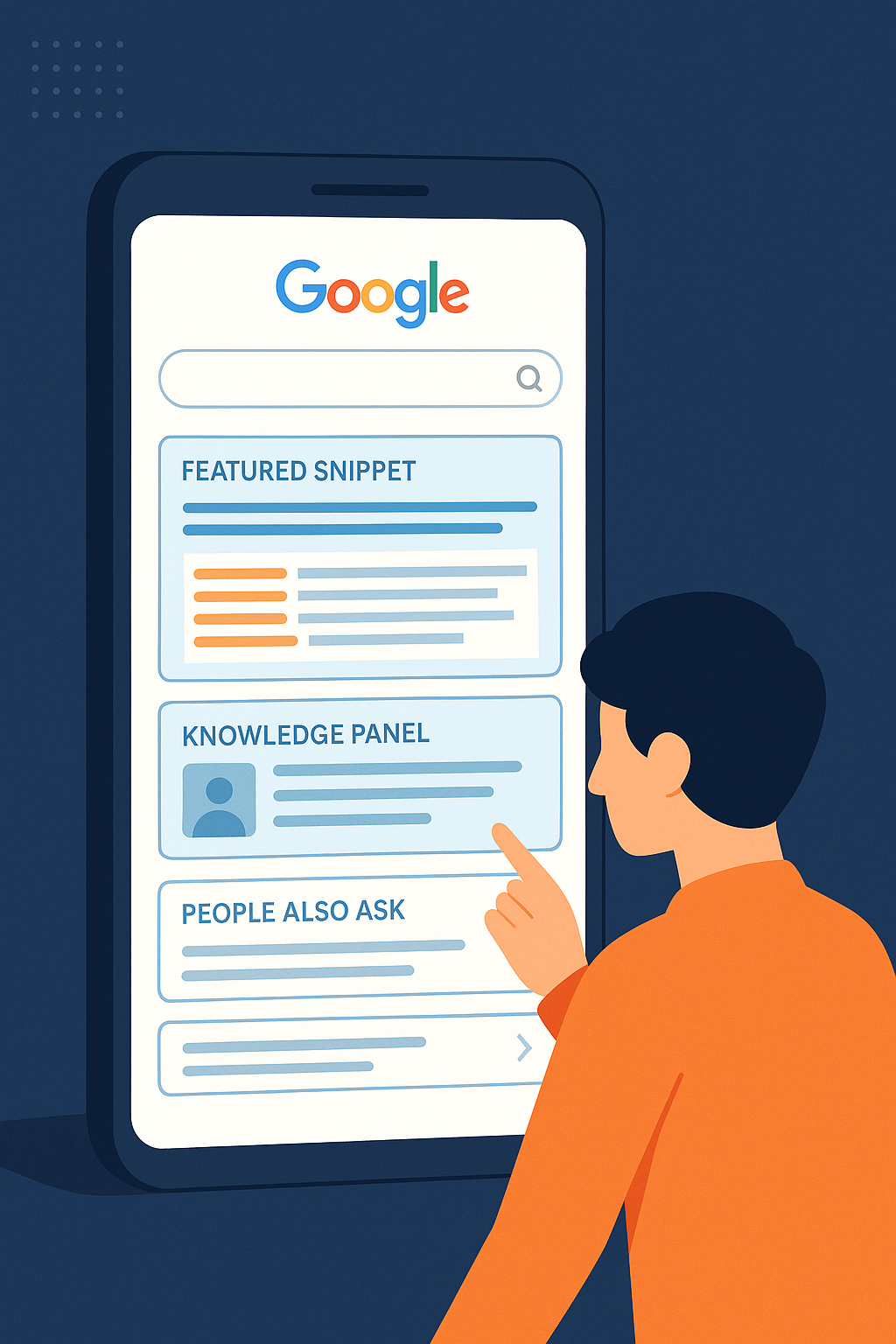
A zero-click search occurs when Google gives users the answer directly from the results page, thus not requiring the user to click through to a website. These answers come in different formats as follows:
| SERP Feature | Description | LSI Type |
| Featured Snippets | Short, concise answers pulled from website content (often paragraphs, lists, or tables). | paragraph snippets, list snippets, table snippets |
| Knowledge Panels | Authoritative profiles or fact boxes—drawn from sources like Wikipedia or official sites. | rich cards |
| People Also Ask (PAA) | Expandable questions and answers that appear below the main result. | answer boxes |
| Google Business | Local business info (hours, contacts, reviews) directly on SERP. | rich cards |
| AI Overviews | AI-generated summaries combining insights from multiple sources. | schema FAQ |
With the help of these SERP features, brands can remain visible in front of the users even when they do not ever press a link.
Why Zero-Click Matters for Tech Brands

Visibility vs. Traffic
Clicks and sessions have been regarded as the primary benchmarks of success in SEO. Nevertheless, in an era that is predominantly ruled by the zero-click model, the impressions and visibility of the brand mostly emerge as the decisive factors. For instance, if a technology product is depicted with the most essential characteristics and benefits in a featured snippet or knowledge panel, it would undoubtedly be the first one on the page and the public would associate the brand with the authoritativeness prior to even visiting the website.
Competitive Differentiation
In bustling sectors such as cloud services, cyber security, or development frameworks, attaining a table snippet that juxtaposes feature sets against competitors is a game changer. As rivals battle it out for positions 2–5, capturing position zero (the snippet) guarantees that your feature set is the first one viewed by engineers, CTOs, and decision-makers.
Influence on Buyer Journeys
Finding the right technology products to buy is not a simple matter; it involves lots of research. When users discover quick solutions—such as “How to configure Kubernetes autoscaling?”—in paragraph snippets, they create prior impressions that are key to their next actions, such as demo requests or trial sign-ups. Zero-click tools initiate trust at the top of the funnel. For more info on how these impressions shape conversions, visit our resource hub.
Strategies to Thrive in a Zero-Click World
1. Optimize for Featured Snippets and Knowledge Panels
- Structure content clearly: Use H2/H3 headings formulated as questions, proceeded by brief answers (40–60 words for paragraphs).
- Implement schema markup: Apply FAQ, HowTo, and TechArticle schema to express intent for answer boxes and rich cards.
- Leverage tables and lists: Apply list snippets for how-to manuals and use table snippets for pricing or tool comparisons.
Tip: Place your key answer immediately below the heading. Google often extracts the first few lines for paragraph snippets.
2. Create High-Value, Question-Based Content
Form a FAQ section that specifically targets the common developer and buyer questions. As an example:
<script type=”application/ld+json”>
{
“@context”: “https://schema.org”,
“@type”: “FAQPage”,
“mainEntity”: [{
“@type”: “Question”,
“name”: “What is zero-click search optimization?”,
“acceptedAnswer”: {
“@type”: “Answer”,
“text”: “Zero-click search optimization focuses on securing visibility within SERP features like featured snippets and knowledge panels…”
}
},
{
“@type”: “Question”,
“name”: “How do featured snippets benefit tech brands?”,
“acceptedAnswer”: {
“@type”: “Answer”,
“text”: “They position your brand as an authority, increasing brand recall even without a site visit.”
}
}
]
}
</script>
3.Utilize Multimedia and Rich Cards
Utilize Multimedia and Rich Cards
- Short Video Clips: You can host brief explanation clips on Youtube along with timestamps; question keywords are put in titles/descriptions to optimize them.
- Image-based responses: Incorporate rich images and infographics that are equipped with ImageObject schema in order to show up in image carousels on SERP.
- Statistics-based charts: Publish benchmark reports (e.g., latency, throughput) rendering results in table format to earn table snippets.
4. Optimize Technical SEO and Page Performance
| Aspect | Why It Matters |
| Mobile-First Design | Over 75% of zero-click searches occur on mobile. |
| Core Web Vitals | Snippet inclusion correlates with fast load times. |
| Secure HTTPS | Google prioritizes secure domains for rich features. |
Keep on auditing the website for issues such as speed, mobile responsiveness, and structured data. At Malinovsky, our team incorporates performance upgrades and schema deployment in all processes so as to make sure that tech brands not only rank but also take over SERP features.
Measuring Success Beyond Clicks
When users do not click at all, traditional SEO reports become defective. So instead, the following metrics need to be observed:
- Impressions in SERP features
- Use Google Search Console to filter for “Position = 0” and “Feature = Featured snippet”
- Use Google Search Console to filter for “Position = 0” and “Feature = Featured snippet”
- Average Position for Brand Queries
- Monitor how often your brand name triggers a knowledge panel
- Monitor how often your brand name triggers a knowledge panel
- PAA Appearances
- Tools like Ahrefs and SEMrush can report your frequency in “People Also Ask”
- Tools like Ahrefs and SEMrush can report your frequency in “People Also Ask”
- Direct and Branded Traffic Growth
- In GA4, watch “Direct” channel trends; rising numbers suggest improved zero-click visibility
- In GA4, watch “Direct” channel trends; rising numbers suggest improved zero-click visibility
- Engagement with Zero-Click Assets
- Track time spent on pages that target snippets; high dwell time indicates satisfaction

| Metric | Tool | Goal |
| Featured Snippet Impressions | Google Search Console | +30% quarter-over-quarter |
| Knowledge Panel Triggers | Brandwatch / Mention | Maintain top-of-page visibility |
| PAA Inclusion Rate | Semrush | Appear in ≥ 50% target queries |
| Direct Traffic Lift | GA4 | +15% year-over-year |
Summary
Zero-click search has become not an option but a significant transformation in the usual way technology brands interest people. By optimizing featured snippets, knowledge panels, and other SERP features your company can capture and hold visibility and authority directly in the search page. You can utilize structured schema FAQ, design visually appealing list snippets, or exhibit product tiers in table snippets which will bring your brand to the forefront.
At Malinovsky, we deal with the formation of the master plans that make use of zero-click search so that your tech solutions win position zero and remain in the spotlight—even when no clicks are made. Accept this new way: help your clients with immediate answers, study visibility instead of clicks, and offer your brand as the best expert without a doubt in an AI-driven search environment that is always changing.